The Baseline, Plus What Changed
Ask an engineer to describe a variant, and often the answer takes one shape: the standard machine, plus a reinforced frame and a modified cooling circuit. Not a parts list: a baseline, and what’s different from it. A familiar pattern, and a consequential one. This article follows that framing into the PLM system, and asks why it usually doesn’t survive the trip.
What Happens to the Difference
This shows up constantly. A global platform sold in forty countries, each with its own market-specific equipment. A base car and a sport package that swaps the seats, wheels, and suspension. A machine family with a standard configuration Configuration (kən-ˌfi-gyə-ˈrā-shən) n. Configuration has three distinct meanings in PLM: variant configuration, configuration management, and parameterization — each describing a different kind of joining. and twelve customer-specific deviations. In each case, someone describes the variant the same way: the standard product, plus a known, bounded difference.
Formal structures for this exist, and they are mature. Feature models capture the options; a 150% BOM holds every part that could ever appear; variant rules select the right ones for each market. This works. But all of it is organized around the superset. You model everything the product could ever be, then filter down. The difference the engineer described (the sport package, the country adaptation) never exists as an object. It is dissolved into option flags across the superset and reconstructed by the filter every time.
Done without that discipline, the same situation degrades into a separate bill of materials, copied from the original, maintained in parallel, drifting from the source. More common than anyone likes to admit. But that is a failure of practice, not proof that the engineer’s framing was wrong.
Three Methods, One Blind Spot
Zoom out, and the textbooks mainly name three types of product configuration. Additive configuration Additive Configuration (ˈa-di-tiv kən-ˌfi-gyə-ˈrā-shən) n. Additive configuration is a method for creating product variants by combining modules via standardized interfaces. Learn its role in variant management. assembles variants from modular components. Subtractive configuration Subtractive Configuration (səb-ˈtrak-tiv kən-ˌfi-gyə-ˈrā-shən) n. Subtractive configuration starts from a 150% BOM containing all possible options and removes components not needed for a specific variant. Common in automotive and ERP. starts from a 150% BOM 150% BOM (ˌwən-ˌfif-tē pər-ˈsent ˌbil əv mə-ˈtir-ē-əlz) n. A 150% BOM lists all possible components across all product variants, serving as the master structure for subtractive configuration in variant management. and removes what isn’t needed. Parametric configuration Parametric Configuration (ˌper-ə-ˈme-trik kən-ˌfi-gyə-ˈrā-shən) n. Parametric configuration defines product variants through adjustable parameters like dimensions and geometry, rather than selecting from a fixed set of discrete options. defines products through adjustable parameters. The taxonomy feels complete. None of the three treats the difference itself as the thing being modeled. Software product lines asked the same question fifteen years ago, and came up with something that could be the fourth answer.
What Delta Modeling Is
In 2010, computer scientist Ina Schaefer and colleagues formalized what they called delta-oriented programming. The idea is simple on the surface. Start with a baseline: a complete, valid product. Define deltas: named modules that describe additions, removals, or modifications relative to that baseline. Apply a sequence of deltas to derive a variant.
The key move is treating the difference as a first-class object. Not a comment in a changelog. Not an engineering change order attached to a document. A delta is defined, versioned, composed. Two deltas applied in the right order produce a valid variant.
It sits outside the three established methods above, each of which starts from a different place. Delta starts from something specific, and describes only what changes.
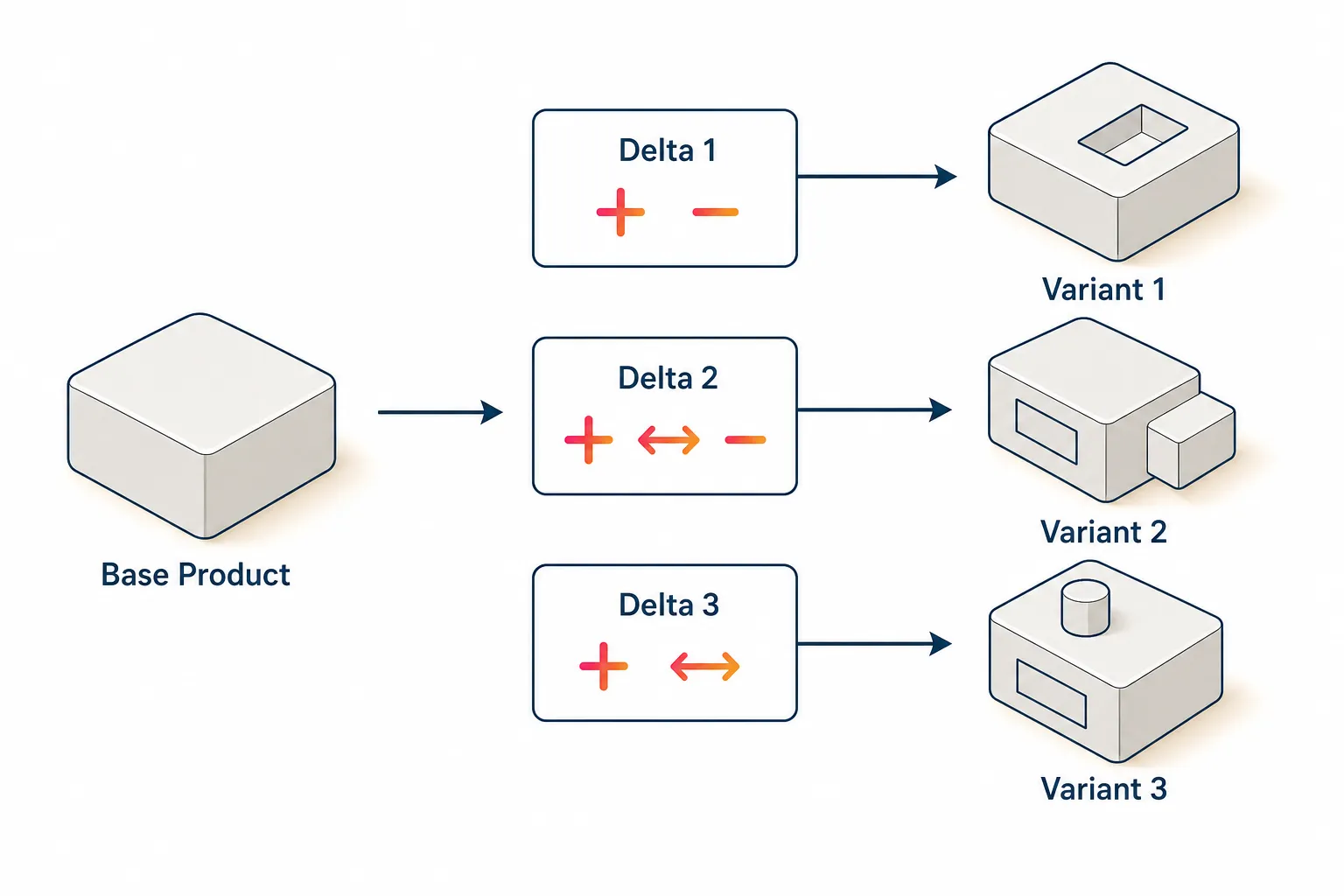
This is what the engineer’s framing was reaching for. Where subtractive filters a superset down to size, the delta model inverts the direction: one baseline, plus forty delta objects (the sport package, the market-X adaptation), each a named thing, each small, each auditable, each reusable when the same condition turns up on the next platform. Same forty variants, opposite starting point. When a variant genuinely is “the base, plus a known difference” (a common way to describe one), the superset is a lot of machinery to express something that was a delta all along.
Where the Transfer Breaks Down
That makes delta sound like the obvious better fit. It isn’t — not for free. The idea comes from software, and software is an easier world. Code has no weight, no tolerances. When two software modules interact, the interface contract is syntactic: checkable by a compiler. When two physical components interact, the interface is mechanical, thermal, electrical, chemical, and nothing checks it automatically. That difference shapes every method in physical variant management, not just delta modeling.
There’s a more specific problem. ERP systems expect complete bills of materials, but that’s true for subtractive configuration too. A 150% BOM also has to be resolved to a 100% BOM before production. The difference is that PLM Product Lifecycle Management (PLM) (ˈprä-dəkt ˈlīf-ˌsī-kəl ˈma-nij-mənt) n. PLM (Product Lifecycle Management) manages product data, processes, and decisions across the full lifecycle — from design through manufacturing, service, and end of life. systems have standard functions for exactly that resolution: variant rules, configuration profiles, option filters. For delta composition, no equivalent tooling exists - at least not as standard in the PLM tools I know.
But missing tooling is the weaker objection. Tools can be built. The harder cost sits in the method itself. Deltas don’t commute: remove a bracket and add a reinforced one, reverse the order, and you get something different, or nothing valid at all. A configuration becomes a sequence of operations rather than a state, and a stack of forty deltas needs a defined application order. That order is one more thing to maintain, and one more thing to get wrong.
So it isn’t simply unsupported. It’s a trade. The difference becomes a first-class object (small, auditable, reusable), and you pay with the order dependence that comes from describing a product as what you did to it, not as what it is.
What There Is to Learn Anyway
The physical world already does something like delta modeling, informally. The clearest case is the retrofit kit: a packaged set of parts and instructions that turns one configuration into another. Add these, remove those, and the machine in the field becomes a different variant. A kit is a difference made physical. It has a part number. It has a bill of materials. It exists as a thing.
But the kit is a deliverable, not a configuration object. It sits beside the product structure Product Structure (ˈprä-dəkt ˈstrək-chər) n. A product structure is the hierarchical decomposition of a product into components and subassemblies — the engineering foundation for BOM management and variant documentation. , not inside it. Nobody composes kits onto a baseline the way a software build composes deltas onto a core. The kit is tracked as logistics, not as configuration. The difference is real, named, even shippable. And still second-class.
The lesson from software isn’t the mechanism. It’s the framing. Delta-oriented programming never became the mainstream way to build software variants: most of that work still runs on feature flags, conditional compilation, and configuration files. But it showed the framing is coherent: you can make the difference the primary artifact, define and compose it in its own right, and derive the complete variant from it. The idea works. It just stayed mostly in research.
Variant management Variant Management (ˈver-ē-ənt ˈma-nij-mənt) n. Variant management: offering individual customers the best fitting solution with minimum internal complexity — a cross-sectional discipline, not a framework. for physical products hasn’t gotten there, not as something mainstream PLM tools offer out of the box. Software, at least in research, worked out that the difference can be formalized: a validated answer sitting on the shelf, unused in most day-to-day practice, but there if someone wants to build on it. Physical variant management has no public equivalent to point to. Some companies almost certainly run something like it internally (a spreadsheet, a script, a process built by someone who already thinks this way), but that stays company-specific, invisible from outside, and it isn’t what a standard PLM system ships with. The retrofit kit is the closest thing visible from the outside, and it stays outside the model. Differences are attached to change processes, buried in revision histories, reconstructed on demand. That has costs. It makes reuse harder. It makes it difficult to ask: which deltas are common across multiple variants? Which could be retired? Which are contradictory?
A requirement for the vendors
Delta may be the more natural modeling perspective for exactly the variants this article opened with: the baseline, plus a bounded set of named changes. The formal model does not match that mental model, and the gap is not inevitable.
There is no architectural reason a PLM or configuration tool could not expose delta modeling as its primary authoring interface, while transforming the result into normalized feature models and Max-BOMs under the hood. The two are not in conflict: they are different levels of the same description. The vendors have not offered this. It would be a reasonable thing to ask for.
Back to the Baseline
The engineer who opened this article wasn’t describing something vague. “The standard machine, plus a reinforced frame and a modified cooling circuit” is a complete, precise description of a variant, right up until it has to enter a system built to see supersets instead of differences. Nothing about that description was the problem. It just had nowhere to go.
Delta modeling gives it somewhere to go — at the price of order. A baseline plus a filed sequence of named changes is a different commitment than a baseline plus a set of independent rules, and that difference is real, not a footnote. The claim here isn’t that delta modeling replaces the three established methods. It’s narrower: for variants that genuinely are “the base, plus a known difference,” the difference deserves to exist as something more than a side effect of a rule set. Today, in most PLM tools, it doesn’t.
FAQ
What is delta-oriented programming?
Delta-oriented programming is a method from software product line research, formalized by Ina Schaefer and colleagues in 2010. The core idea: start from a single valid baseline product, then define named deltas: modules that describe additions, removals, or modifications relative to that baseline. A variant is derived by applying a defined sequence of deltas to the baseline. The key move is treating the difference itself as a first-class object that can be defined, versioned, and composed, not just a comment in a changelog.
How does delta modeling differ from a 150% BOM approach?
A 150% BOM (Max-BOM) defines a superset containing every part that could appear across all variants, then uses variant rules to filter it down to a specific product. Delta modeling inverts this: one baseline, plus a set of named delta objects, each describing a bounded, specific change. For variants that genuinely are “the standard product plus a known difference,” the Max-BOM requires translating that mental model into option flags distributed across a superset. Delta modeling keeps the difference as a direct, auditable object.
Can delta modeling be applied to physical product variants?
In principle yes. However, standard PLM tools have no native support for delta composition; Max-BOM resolution is a built-in function, delta application is not.
Why would a delta-based authoring interface in PLM tools be useful?
Engineers often already think about product families in delta terms: “this variant is the standard machine, plus a reinforced frame and a modified cooling circuit.” Current PLM tools require translating that mental model into feature flags spread across a 150% BOM, an indirection that makes individual differences harder to track, audit, and reuse across platforms. A tool that exposed delta modeling as its authoring interface (while transforming the result into normalized feature models and Max-BOMs internally) would align the modeling surface with how engineers actually reason about variant families.